How to Control Tight Tolerances in Precision CNC Machining
In precision CNC machining, tight tolerances are critical for parts that require stable dimensions, reliable assembly, and consistent performance. In many industries, dimensional accuracy is not just a technical requirement. It also has a direct influence on product quality, assembly efficiency, and long-term reliability. If dimensional control is not managed carefully, the final parts may not fit correctly, may perform inconsistently, or may require extra adjustment during assembly.
From our experience, controlling tight tolerances is never the result of a single step. It depends on the combined effect of machine condition, tooling, material behavior, process planning, temperature control, and inspection. In practical machining work, we focus on the full manufacturing process rather than only the final measurement result. This is especially important for projects involving precision machined parts, mold components, and custom assemblies with strict fitting requirements.
Why Tight Tolerance Control Matters
Tight tolerance parts are often used in assemblies where even a small dimensional variation can directly affect function. This is common in precision fixtures, mold components, mechanical assemblies, and custom metal parts with matching requirements. A small deviation may lead to poor fit, excessive friction, looseness, alignment error, or reduced product life.
Good tolerance control helps support:
- Stable assembly performance
- Reduced rework
- Better part interchangeability
- More consistent batch production
- Lower risk of customer complaints
For a machining supplier, strong tolerance control also reflects process capability and manufacturing reliability. In our machining work, this is one of the key factors we pay close attention to when producing precision CNC machined parts for customers with strict dimensional requirements.
1) Start with a Suitable Material Strategy
Material behavior has a direct influence on dimensional accuracy. Different metals respond differently during cutting, clamping, and temperature change. Aluminum is generally easier to machine, but thin sections may move more easily. Stainless steel can create more cutting stress and heat. Copper may also require more careful process adjustment because of its softness and cutting behavior.
Before machining begins, we usually evaluate:
- Material hardness
- Internal stress condition
- Thermal expansion behavior
- Cutting characteristics
- Whether stress relief is needed
If the material itself is unstable, holding a tight tolerance becomes much more difficult even with good equipment. This is one reason why material selection should always be considered early in a precision CNC machining project, especially when the final part also has surface finish or assembly requirements.
2) Maintain Stable Machine and Fixture Conditions
Machine accuracy and fixture stability are basic requirements for tolerance control. If the spindle condition, guideway accuracy, or machine rigidity is not stable, dimensional variation is more likely to appear. The same is true if the clamping method is not suitable.
In precision machining, excessive clamping force may deform the part, especially when machining thin walls or small components. Weak clamping, however, may lead to vibration or position shift during cutting.
A more reliable setup usually includes:
- Stable machine condition
- Suitable clamping force
- Proper support for weak areas
- Minimized vibration during cutting
- Repeatable positioning between operations
In many cases, tolerance problems are not caused by cutting parameters alone, but by instability in setup and fixturing. In our experience, fixture planning is just as important as machining accuracy when the goal is repeatable production of tight-tolerance components.
3) Choose Tooling and Cutting Parameters Carefully
Tool condition plays a major role in dimensional consistency. Worn tools may cause size drift, surface instability, and poor repeatability. Different materials also require different tool types and cutting strategies.
To improve tolerance control, we usually pay attention to:
- Tool material and geometry
- Tool wear condition
- Cutting speed and feed rate
- Depth of cut
- Heat generation during machining
For example, if the cutting load is too high, the tool and workpiece may deflect slightly, which can affect the final size. If heat builds up during long machining cycles, thermal expansion may also change the measured result.
Stable cutting conditions are especially important in finishing operations where the final tolerance is being achieved. This is also closely related to the final surface finish of machined parts, since unstable tooling often affects both dimension and appearance at the same time.

4) Use a Reasonable Machining Sequence
Process planning is a key part of holding tight tolerances. Rough machining, semi-finishing, and finishing should be arranged in a way that reduces stress release and supports dimensional stability.
A common mistake is to machine a part to final size too early, before the part has fully stabilized. In some cases, rough machining may release internal stress and cause slight deformation. If there is no allowance left for later finishing, the final size may go out of tolerance.
A more practical machining sequence may include:
- Leaving suitable machining allowance
- Separating roughing and finishing operations
- Controlling heat and stress during machining
- Finishing critical surfaces at the correct stage
- Rechecking datum surfaces before final cuts
The order of machining can be just as important as the cutting accuracy itself. In our production planning, we usually review the machining sequence carefully before starting parts with tight tolerances or complex geometries.
5) Control Temperature and Environmental Influence
Temperature can influence precision machining more than many people expect. Metal expands and contracts with temperature change, and this effect becomes more noticeable when tolerances are tight.
Heat may come from:
- The cutting process
- Machine operation over time
- The workshop environment
- Part handling after machining
If a part is measured immediately after heavy cutting, the result may not fully represent its stable final condition. For this reason, temperature awareness is important in both machining and inspection.
Better dimensional consistency often depends on:
- Controlling excessive cutting heat
- Allowing parts to stabilize before final measurement
- Keeping the inspection environment relatively stable
- Avoiding measurement immediately after strong thermal influence
When customers require high dimensional accuracy, we generally treat temperature control as part of the machining process rather than as a separate inspection issue.
6) Strengthen Inspection During the Process
Final inspection is important, but in-process inspection is often what prevents batch problems. If measurement is only done after all parts are finished, it may be too late to correct dimensional drift efficiently.
For tight tolerance work, it is often helpful to check:
- Datum surfaces after initial operations
- Key sizes after semi-finishing
- Critical dimensions during finishing
- Repeatability across the batch
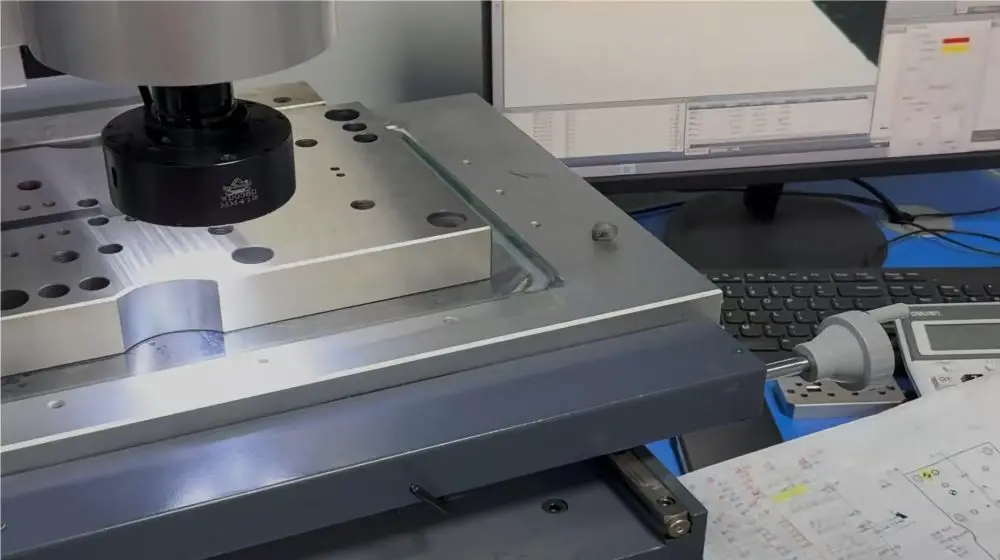
Inspection tools may include calipers, micrometers, height gauges, bore gauges, or CMM systems depending on the part requirement. The goal is not only to confirm size, but also to verify that the process remains stable.
In our view, process inspection is one of the most effective ways to support both part accuracy and production consistency. It helps identify small deviations earlier before they affect the full batch.

7) Consider Batch Consistency, Not Just Single-Part Accuracy
A part that meets the drawing once is not enough if the rest of the batch shows variation. True tolerance control means the process can repeatedly produce acceptable parts from the first piece to the last.
Batch consistency is affected by:
- Tool wear over time
- Machine temperature change
- Fixture repeatability
- Operator handling
- Material variation between pieces
For repeat production, process control should focus on maintaining consistency throughout the entire batch. This is especially important for mold components, matching parts, and assemblies with multiple fitted features.
When we evaluate a machining process, we do not only look at whether one sample part meets the drawing. We also look at whether the full process can remain stable during continued production. That is what helps support long-term quality in precision CNC machined parts.
Conclusion
Controlling tight tolerances in precision CNC machining depends on more than accurate equipment alone. Material stability, machine condition, fixturing, tooling, process planning, temperature control, and inspection all work together to influence the final result.
A practical machining process should aim not only for one qualified part, but for stable and repeatable production. When these details are managed carefully, tight tolerance machining can better support product quality, assembly reliability, and long-term manufacturing consistency.
At Zecheng Precision Mold Company, we understand that customers who need precision CNC machining often care about more than final dimensions alone. They also care about consistency, surface quality, and reliable production results. If you are sourcing precision CNC machined parts with strict dimensional requirements, we would be glad to discuss your material, tolerance, and manufacturing needs.
Common Challenges in CNC Machining Stainless Steel Parts